Saturday, October 11, 2025

Ben Franklin's alphabet

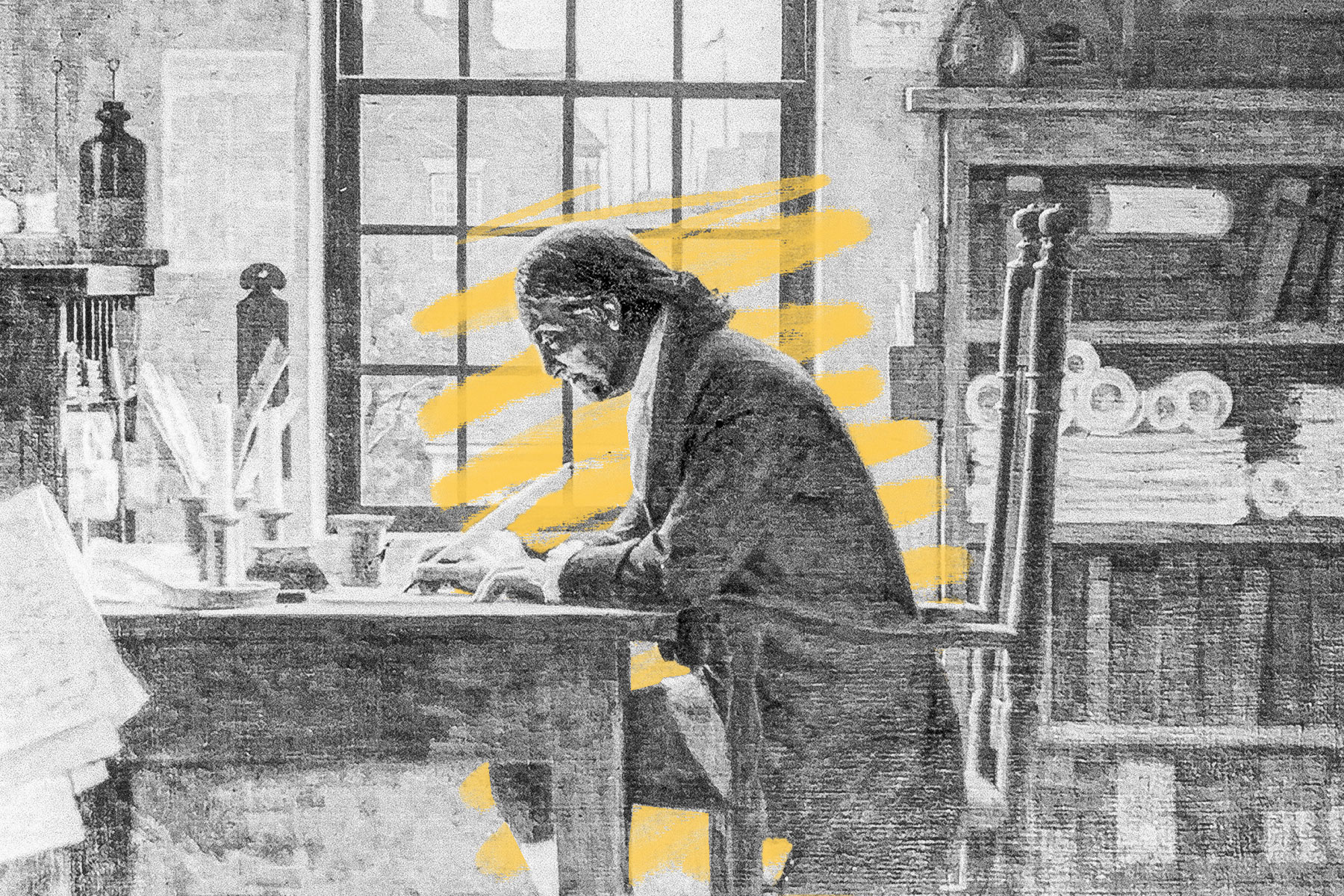
When he wasn't busy experimenting with electricity or dismissing our national symbol as "a bird of bad moral character," America's most eclectic founding father had an even stranger pastime: creating a new alphabet

Benjamin Franklin created a new alphabet.

Famous Figures

W hen he wasn't busy experimenting with electricity or dismissing our national symbol as "a bird of bad moral character," America's most eclectic founding father had an even stranger pastime: creating a new alphabet. Benjamin Franklin began working on what he called a "Reformed Mode of Spelling" in 1768, envisioning his phonetic alphabet as "a more natural order" that consisted mainly of "sounds formed by the breath, with none or very little help of tongue, teeth, and lips; and produced chiefly in the windpipe." He removed six consonants he considered superfluous — c, j, q, w, x, and y — while also adding two new vowels and four new consonants.

Under Franklin's system, each letter could be pronounced only one way (hence why letters such as "c," which have both "soft" and "hard" pronunciations, were removed). "Long" vowel sounds were achieved by simply using the letter twice in a row. This, he reasoned, would lead to fewer misspellings. Franklin tested his alphabet in a 1768 letter to Polly Stevenson, the daughter of his landlady in London, that ends with "ษฅi am, mษฅi diir frind, iurs afeks̸ษฅnetli, B. Franklin" — "I am, my dear friend, yours affectionately, B. Franklin." Given the fact that you've likely never read such a sentence before, you already know that the alphabet never caught on.

By the Numbers

Year Franklin's alphabet was published in Noah Webster's Dissertations on the English Language

1789

Letters in Franklin's alphabet

26

Year Franklin proposed uniting the American colonies

1754

Letters in the Khmer (Cambodian) alphabet, the largest in the world

74

Did you know?

Ben Franklin's son was a loyalist during the Revolutionary War.

The American Civil War wasn't the only U.S. conflict that pitted family members against one another, as the relationship between Benjamin Franklin and his son William reminds us. As the British-appointed governor of New Jersey, William Franklin implored the state Legislature to remain loyal to the British crown during the American Revolution, and achieve "peace, happiness, and a restoration of the public tranquility" rather than "anarchy, misery, and all the horrors of a civil war." Born in 1730 to an unknown mother and raised by his father's common-law wife Deborah Read, the younger Franklin was considered a capable governor and was encouraged to join the revolution. He refused, and after being placed under house arrest and removed from the governorship by the Continental Congress in January 1776, he was later imprisoned in Connecticut. He fought for the loyalists upon his release and, following the American victory, never reconciled with his father.

Recommended Reading

Arts & Culture

Why Do We Have Middle Names? 

Famous Figures

What the U.S. Presidents Did Before Taking Office

+ Load more

Discover something new

History Facts is part of Optimism, which publishes content that uplifts, informs, and inspires.

13 Surprising Facts About the World's Population
Interesting Facts Interesting Facts

Natural Cold Remedies That Actually Work
Better Report Better Report

Why Do Brits Spell "Colour" With an "ou"?
Word Smarts Word Smarts
Click here

No comments:

Post a Comment