Dear Reader,
This is Dylan Jovine with Behind the Markets.
Happy Thursday.
Today is Thursday, February 12th.
We've had construction in our office — they're redoing the roof. Lots of hammering, noise, tar smells… the whole thing. I told the team not even to show up this week.
But I had to sneak in today.
We ran a Dylan's Diary rerun yesterday, but I needed to come in and talk about a note from Bank of America that's sounding the alarm on the U.S. dollar.
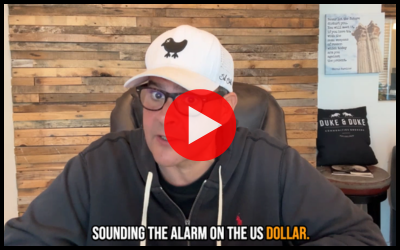
And they're talking about the exact things we've been discussing for years.
Policy uncertainty.
Rising U.S. debt levels.
According to the bank, a "disorderly" dollar decline would mean a drop of more than 5% in a single month. And they warn that could trigger a dramatic selloff in long-term Treasuries, tighten financial conditions, spike interest rates — and create domino effects that would not be pretty.
This is serious.
And it's something we've been talking about since 2022, when we published The Death of the Dollar.
Back then, we saw that policies under both administrations — Trump's first term, Biden's term, and now Trump's second term — were putting real pressure on the dollar's long-term standing.
What's happening now is that the things we laid out in 2022 are finally being discussed openly on Wall Street.
That's why this Bank of America note matters.
It doesn't mean we're "smarter" than Bank of America or Goldman or JPMorgan.
It means we're independent.
If you're a major bank, the government is one of your largest customers. You can't just come out and say, "Hey, the dollar is losing reserve status."
We can.
We don't have to worry about offending anyone. We just follow the logic.
And the logic is this:
The dollar is slowly being replaced as the world's reserve currency — and gold is filling that gap.
Look at China.
They run roughly an $80 billion per month trade surplus with the United States — close to a trillion dollars a year.
They used to take those dollars and recycle them into U.S. Treasury bonds.
They've stopped.
Now they're buying gold.
That's what we mean when we say the dollar is losing its reserve role.
They're not financing our debt anymore. They're accumulating hard assets.
And it's not just China.
Other countries are doing the same thing.
Mark Carney, for example — former head of both the Bank of Canada and the Bank of England. You think Canada is eager to keep increasing Treasury purchases in this environment?
What's happening right now is accelerating a process that was already underway.
And let's be clear — this didn't start with one party.
When the Biden administration seized Russia's central bank assets after the Ukraine invasion, it sent a message to every country on Earth:
"If you hold U.S. Treasuries and do something we don't like, we can freeze your assets."
That was a turning point.
China capitalized on it immediately.
They began telling other nations: maybe you're not ready to replace the dollar with the yuan — but at least diversify. Buy gold. Reduce dollar exposure.
And that's exactly what's happening.
I am telling you — this is one of those decisions that will go down in history.
If the dollar loses its reserve currency status, Americans will be instantly poorer.
Twenty-five to thirty percent poorer.
Your stock portfolio? Down 25–30%.
Your home? Down 25–30%.
Your purchasing power? Down.
Some analysts argue it could be closer to 40%.
That's how much the "exorbitant privilege" of reserve status is worth.
And this is why gold hasn't been rising by accident.
It hasn't been a meme. It hasn't been speculation.
It's been central banks repositioning in plain sight.
And after gold's massive surge, a lot of readers have written asking me the same question:
"Have I already missed it?"
I don't believe so.
Because if what Bank of America is now warning about continues… the next leg of this shift won't look like the first one.
It will be bigger.
And it will be driven less by retail enthusiasm… and more by institutional capital reallocating.
I lay out everything here — not as a flashy prediction, but as a framework for understanding where capital flows when confidence in a currency begins to erode.
If you understand that framework, you stop reacting to headlines — and start positioning ahead of them.
Listen, we've been sucking in global capital for decades. That's allowed us to run deficits, issue debt, and keep interest rates lower than they otherwise would be.
If that changes, the adjustment will not be gentle.
And this is not partisan.
Presidents of both parties have contributed to this trajectory.
I don't see the world in red and blue.
I see it in incentives and consequences.
Right now, the consequence of our policy choices is that China's long-term strategy is being helped along.
And if you have children and grandchildren, you cannot underestimate how much losing reserve currency status would change their future.
Anyway, that's what's on my mind today.
Have a wonderful day.
I'll see you tomorrow.



No comments:
Post a Comment