Tuesday, September 30, 2025

What's the most valuable U.S. bill?

Money might seem like an odd collector's item, given that we tend to think of a $100 bill as being worth, well, $100.

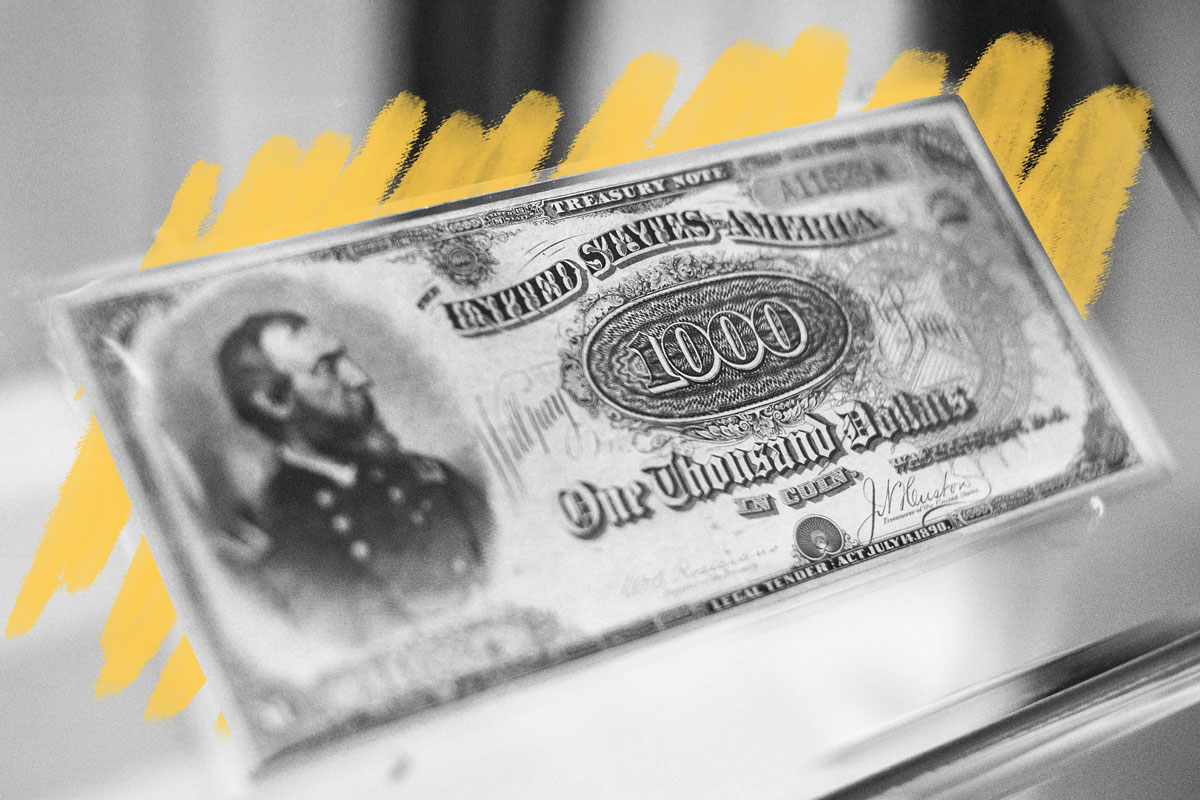
The most valuable U.S. bill is the 'Grand Watermelon' $1,000 Treasury Note.

U.S. History

M oney might seem like an odd collector's item, given that we tend to think of a $100 bill as being worth, well, $100. But several discontinued banknotes are worth far more than face value. That's especially true of the 1890 $1,000 Treasury Note nicknamed the "Grand Watermelon," which, with a valuation of $3.3 million, is now considered the most valuable U.S. bill. 

No actual watermelons adorn the note, alas, but the wide, green zeros on the reverse bear a striking resemblance to the beloved fruit. A portrait of George Meade, a Union general during the Civil War, is on the obverse (front). The bill didn't last long, as neither the Treasury Department nor the public was enamored with the design, and only 18,000 were produced.
As for why it's so valuable more than 130 years later, the answer is simple: scarcity. There are only three known collectible examples of the "Grand Watermelon" note still in existence, one of which sold for $3.29 million in January 2014. Also quite valuable is the 1891 Red Seal $1,000 Treasury Note, with one selling for $2.5 million in April 2013. Maybe one day your 50 State Quarters will fetch a similar price.

By the Numbers

Largest denomination of U.S. currency ever minted

$10,000

Gross domestic product of the U.S. as of 2024

$29.2 trillion

Cost to produce a single penny

3.69¢

Double folds required to tear a U.S. banknote

4,000

Did you know?

The $2 bill is still printed.

Despite being thought of as a collectible, the $2 bill is still printed in the United States — albeit at smaller quantities than it used to be. Its reputation is apparently self-perpetuating, as the reason so few of them are used as actual currency is that most people prefer to hang on to them instead.  The bills have been in circulation since 1862, when the U.S. first started printing paper currency, except between 1966 and 1972, when the Federal Reserve decided they'd outlived their usefulness. Once $2 bills returned from their six-year hiatus, hardworking Americans began collecting them rather than exchanging them for goods and services. The Federal Reserve estimates that there are still 1.7 billion $2 bills in circulation. That's not a lot when compared to the 14.9 billion $1 bills that are out there, but it's not exactly rare, either.

Recommended Reading

Famous Figures

How Many Children Did Each President Have?

World History

5 Military Strategies That Shouldn't Have Worked But Did

+ Load more

Discover something new

History Facts is part of Optimism, which publishes content that uplifts, informs, and inspires.

13 Surprising Facts About the World's Population
Interesting Facts Interesting Facts

Natural Cold Remedies That Actually Work
Better Report Better Report

Why Do Brits Spell "Colour" With an "ou"?
Word Smarts Word Smarts
Click here

No comments:

Post a Comment