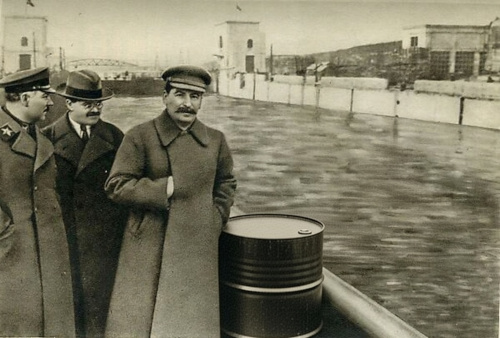
 Practical Investment Analysis for the New Energy EconomyWhen Oil Forecasts Meet RealityThere's a famous Soviet photograph of Stalin walking along a canal with Nikolai Yezhov, one of the men who helped run the terror. You know the one. Then Yezhov fell out of favor, and with the snap of a finger, the photo was changed, and history with it. Yezhov vanished, airbrushed out like a smudge on glass. This is a perfect metaphor for the International Energy Agency's ability to accurately forecast oil markets.
The IEA doesn't just retouch photos, it reshapes baselines. Whether it's a year later, or a quarter later, the "official" story gets quietly rebalanced. Demand revised upward as those "missing barrels" were found, and the IEA's inventory data reshaped as if their report were nothing but an early draft. OPEC's own Secretary General has been unusually blunt about this, pointing to repeated IEA upward revisions and the recurring "missing barrels" problem. But let's be brutally honest here — is the IEA's deception REALLY a surprise? Of course not. I know the veteran members in our investment community here clearly remember the IEA's bombshell confession last May, when it made some rather bold historical revisions. Now drop that habit into the most popular bedtime story of early 2026 — the coming Q1 glut. The IEA's Oil Market Report in January lifted demand growth for 2026 to 930 kb/d, yet still projected a massive surplus for the year, warning a "significant surplus" could show up in the first quarter unless disruptions arrive. And yet, oil prices refuse to pose for that photograph, with Brent now creeping back to $70 per barrel and WTI within a hair of $65 per barrel. So much for $50/bbl oil, right? That's the tell, folks. Because when the narrative cries wolf over an unprecedented supply glut, yet prices refuse to respond, it usually means the true supply/demand balance is far tighter than the headlines insist. Gold Just Marched Above $5,100 — Here's What Comes Next The market is speaking again: gold hasn't lost its momentum. After the recent sell-off, gold has once again reclaimed levels above $5,100 an ounce, proving its resilience amid a mix of geopolitical uncertainty, central bank buying, and shifting macro currents. This isn't a random bounce. It's confirmation that major buyers — from institutions to sovereign reserves — still see gold as essential in an unpredictable world. Enter NatGold — a digital token secured by real, in‑ground gold. Blockchain‑verified. Fully audited. No mining. No middlemen. It's gold ownership redesigned for today's reality — where certainty matters more than ever. Click here to claim your NatGold today. When IEA Forecasts Meet Reality Let's not mince words. The last decade of tracking the oil sector has taught us a simple lesson: official data isn't as reliable as one might think, especially when the inputs are fuzzy and the reports published are inevitably revised at more convenient times. The IEA's case for oversupply leans hard on two pillars: strong supply growth and a big buffer of inventories built during 2025. In that January oil report, it argued that non-OPEC+ supply growth and the stored surplus create a cushion "well in excess of demand," which is exactly how you get complacency priced into oil equities. Here's the problem... continuously revising history means that your supply cushion is more likely an illusion. Granted, the IEA often attributes the mismatch to inventory movements where data are limited, lags in reporting, and ongoing updates to supply/demand numbers. That's not a scandal, but rather a confession that the global oil balances, especially outside the OECD, are more estimates than anything. So when you hear "massive incoming supply glut," you should translate it into a more honest sentence:
Don't hold your breath on that one. Just a few days ago, oil prices were finding support from U.S.-Iran tensions even as U.S. crude stocks jump by 8.5 million barrels in the latest EIA weekly oil report. Meanwhile, OPEC's numbers only show a small surplus if January output levels persist, and the full-year 2026 balance can even tilt to a deficit under unchanged production assumptions. That's not "drowning," by the way — it's one misstep away from a price spike. For the record, here's what makes the "glut" story easy to overstate right now.
For the record, this is exactly how underdog sectors suddenly outperform everyone else — not when the fundamentals are perfect, but when the crowd is still leaning the wrong way. Trump vs. Musk Explodes — But DOGE Payouts Keep Flowing Musk may be out, but Trump's DOGE program is still redirecting billions to taxpayers.
Welcome to the New "Peak" Look, "peak oil" gets pitched like a date on the calendar. For decades, too much focus was given on an exact date that global oil production would peak and enter into an irreversible decline. The reality is that it's far more nuanced than you might realize. Peaks are likely plateaus as growth dries up from a low-oil price environment. Never forget that the cure for low oil prices IS low oil prices. Suddenly, marginal projects are delayed. Drilling programs thin out. Service costs reset, capital spending tightens, and growth plans turn into survival plans. Even the institutions that sound most confident about "too much oil" quietly acknowledge the dependency. The IEA's own outlooks tend to hang on supply growth continuing and "activity in the US shale patch" avoiding meaningful downshifts (spoiler: it won't). In other words, they assume that the drillers blindly ignore cheap oil and keep plugging away. While it's true that the market can have a soft patch; inventories CAN build and first quarter maintenance can make the tape look heavier than it is. That's why this moment matters. The opportunity still lies in uncovering the oil stocks that can weather cheap oil long enough for the cure to arrive. Let me show you one of the best players in the Permian oil patch. Until next time,
Keith Kohl A true insider in the technology and energy markets, Keith's research has helped everyday investors capitalize from the rapid adoption of new technology trends and energy transitions. Keith connects with hundreds of thousands of readers as the Managing Editor of Energy & Capital, as well as the investment director of Angel Publishing's Energy Investor and Technology and Opportunity. For nearly two decades, Keith has been providing in-depth coverage of the hottest investment trends before they go mainstream — from the shale oil and gas boom in the United States to the red-hot EV revolution currently underway. Keith and his readers have banked hundreds of winning trades on the 5G rollout and on key advancements in robotics and AI technology. Keith's keen trading acumen and investment research also extend all the way into the complex biotech sector, where he and his readers take advantage of the newest and most groundbreaking medical therapies being developed by nearly 1,000 biotech companies. His network includes hundreds of experts, from M.D.s and Ph.D.s to lab scientists grinding out the latest medical technology and treatments. You can join his vast investment community and target the most profitable biotech stocks in Keith's Topline Trader advisory newsletter.
|

 Check us out on YouTube!


No comments:
Post a Comment