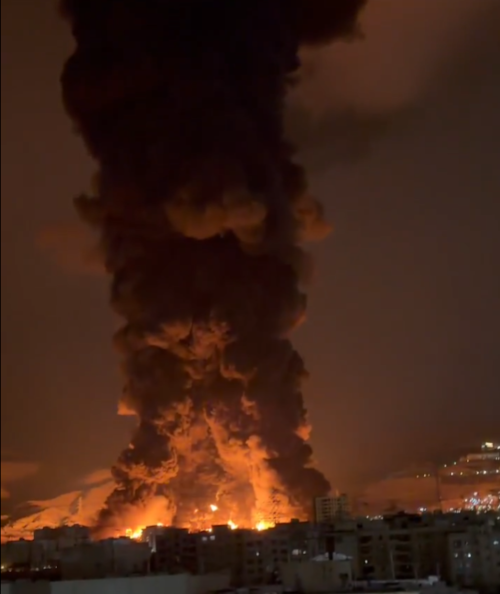
 Practical Investment Analysis for the New Energy EconomyOil Soared Past $100, What's Next? $200?For 10 days, the oil market has been waiting for $100 oil to hit. All it took was the thick dark haze of smoke to roll across the skies of the Middle East this past weekend. The moment trading opened yesterday for WTI crude, not only did we see prices breach $100 per barrel, they surged to $120 per barrel. If you're asking yourself what could have possibly spooked traders into spiking oil prices, let me give you the nightmarish scene on the outskirts of Tehran:
That's what it looked like when Israel struck several fuel depots. The 11 storage tanks at the facility hold approximately 260 million liters of refined product, which is roughly three days' worth of fuel for the city. By the time WTI crude started trading again on Sunday, we saw the repercussions of Israel's strike. In Saudi Arabia, a drone attack targeted Saudi Aramco's 250,000 bbls/d Berri oil field. The U.S.-operated Sarsang oil field in the Kurdistan region of Iraq was shut-in after being attacked. Meanwhile, shipping traffic plummeted to just two brave vessels willing to make the run — that's as close to being closed as we're going to get, especially with the conflict escalating to new heights. Truth is, it's much harder to tell traffic these days with the amount of GPS spoofing going on. Even if some traffic makes it through — including Iranian tankers bound for China — the fear of attack is palpable as a lot of tankers remain stranded. For 46 years, Iran's threat to close the Strait of Hormuz was the most reliable bluff in geopolitics. They rattled the saber in the 1980s when Iraqi bombs were landing on their tankers, then again in 2008 when Washington threatened sanctions. Even more threats to close the Strait were issued in 2012 when the European Union actually imposed those sanctions. Time and again, closing the Strait of Hormuz became the go-to bluff… in 2018, in 2019, in 2025 — every time the pressure rose, Tehran pointed at that narrow 22-mile strip of water and told the world what would happen if anyone pushed them too far. And every single time, the oil market flinched, shrugged, and moved on. Well, they're not crying wolf anymore. This time, they didn't need mines, nor a naval blockade to get the job done — just a few cheap drones and a fax to the insurance market did the job in 72 hours. So now that crude has soared over $100/bbl this weekend, you're probably wondering what comes next? Well, things are going to get much worse before they get better. Trump's Bold Move to Kill the IRS — $21,307 Payouts IncomingTrump just launched a $1 trillion National Fund to replace taxes with direct payouts. Everyday Americans could claim up to $21,307 — but only if they act before the first checks go out. The Strait closure set off a chain reaction that had nothing to do with drones or missiles. As tanker traffic halted, Gulf storage facilities began filling. Full tanks mean stopped pumps. Iraq's Rumaila oil field — the country's largest, producing roughly 1.5 million barrels per day, operated by BP — shut down entirely because there was nowhere to put the oil. The Ceyhan pipeline, which carries Kurdish crude north through Turkey to Mediterranean markets and had served as Iraq's main route around Hormuz, was suspended too. Of course, Northern and southern Iraqi exports went dark simultaneously, and Kuwait followed with precautionary production cuts…. the UAE is next in line. And here's the key to the volatility associated with closing the Strait of Hormuz — the repercussions extend far beyond having a few hundred tankers stranded on the water. You see, it triggered production shutdowns across OPEC's second-largest producer without a single missile touching an Iraqi oil well. That's the part that should be keeping energy analysts awake at night. This past weekend, Iran decided the Strait wasn't enough. Meanwhile, Saudi Arabia's Ras Tanura refinery — which processes over half a million barrels per day and serves as the loading terminal for the world's largest oilfield — had already been hit by Iranian drones the week prior and taken offline. Iran struck Dubai, Abu Dhabi, Kuwait, Bahrain, and Doha. A desalination plant in Bahrain took a hit — the first water infrastructure casualty of the war. In fact, Iranian missiles reached as far as Azerbaijan, where they took aim at a key oil pipeline and disrupted another 500,000 barrels per day. Let's face it, the entire Gulf energy complex is now operating under active threat. When Israeli aircraft struck those 30 Iranian fuel storage facilities in Tehran and the surrounding Alborz province over the weekend, igniting fires that burned for hours and blanketed a city of ten million in thick black smoke, residents reported black rainfall staining everything around them. Iran's parliament speaker warned that if infrastructure attacks continue, Tehran will retaliate in kind — and that Iranian spokesmen have now explicitly threatened that a symmetric response could push oil to $200 a barrel. That's right, dear reader, if this war drags on for weeks or months, people just might get their wish of seeing $200 oil. Even Washington is getting rattled a little, spooked by Israel's strikes going well beyond what they expected after being notified in advance. So when the IRGC retaliated by firing Kheibarshekan missiles at the Haifa oil refinery in northern Israel in direct retaliation for the Tehran depot strikes, you can't help but wonder how much worse things could get going forward. So the box score after nine days reads as follows:
And WTI crude, which opened this year below $60 a barrel, traded above $100 per barrel this morning — its highest level since the summer of 2022. If you ask how things can get worse, keep two things in mind. We've already talked about how Saudi Arabia is trying hard to run an end-around by utilizing the East-West pipeline. But now you can't help but wonder when Kharg Island — the single facility through which roughly 90% of Iran's crude exports flow — will come into play. After all, the U.S. and Israel have struck nuclear sites, leadership, military infrastructure, fuel depots, and missile production facilities. Yet, they haven't touched Kharg. If that calculation changes, the analysts currently forecasting $120/bbl oil will be revising toward $150/bbl before the ink dries. In fact, JPMorgan has already said a prolonged disruption puts oil at $120/bbl; Bank of America's commodity desk has modeled a $40 to $80 per barrel spike on top of current prices under a full Hormuz closure scenario. Kharg is the floor that hasn't been removed yet. Trump has said this war will last weeks, possibly longer. Now the market is starting to believe him. Bigger Than the Epstein Files... You were never meant to see this. These are the stocks the U.S. government is quietly buying. When Trump declares an asset "essential to defense," shareholders get paid — fast. Five tiny stocks are next. Three already fast-tracked under a 28-day wartime order. 👉 Access Trump's Secret Stock Buying List now — before it disappears. Oil Crisis Breed Opportunity The investment case here has two distinct layers, and most people are only paying attention to one of them. The obvious trade is U.S. crude producers — specifically the Permian Basin operators who spent 2025 surviving sub-$60 oil by keeping their balance sheets clean and their acreage intact. With WTI over $100 a barrel, every marginal well that looked uneconomical six months ago is finally printing money. So the question isn't whether these companies will benefit (spoiler: They will). It's whether the conflict lasts long enough to justify redeploying capital into new drilling. That distinction matters more than most people realize. A short, decisive war — about three to four weeks — lifts prices temporarily, rewards existing production, and then fades as the Strait reopens and tankers reposition. Operators who held their rigs in place benefit quietly, and nobody accelerates a drilling program for a four-week spike. A prolonged conflict is a different conversation entirely. But what if the Strait remains functionally closed for two months or more, if Kharg Island enters the equation, or even if Gulf storage overflow forces sustained production shutdowns across Iraq and Kuwait — at that point, operators with permitted acreage, drilled-but-uncompleted wells, and the balance sheet to move quickly become the most valuable energy assets on earth. The Permian Basin, which accounts for nearly half of total U.S. crude production, doesn't need the Strait of Hormuz, nor is it concerned with war-risk insurance. Companies will pump oil overland to Gulf Coast refineries and out through deepwater ports with no Iranian drone in the shipping lane. With oil at $100 a barrel, the breakeven math for new Permian wells — an average of about $65 per barrel — looks almost quaint. However, perhaps the more overlooked opportunity in this Middle East crisis isn't who's pulling oil out of the ground, it's the players refining and exporting the products on the other side. There's no question that our Gulf Coast refiners are sitting in an extraordinary position right now. Those facilities are among the largest and most sophisticated in the world, and they run on domestic crude that won't be disrupted by a single drone. Then, those highly sought after petroleum products — gasoline, diesel, jet fuel — will flow into a global market where Middle Eastern refining capacity has just been partially knocked offline. Ras Tanura is down, Qatari facilities have been hit, and the downstream product flows that normally move through the Strait of Hormuz — diesel to Asia, jet fuel to Europe, petrochemical feedstocks to everywhere — have been curtailed along with the crude. Right now, there are very few places on earth with the refining capacity, the export infrastructure, and the domestic crude supply to fill it. The war may or may not last. The opportunity, however, is very much open right now. Until next time,
Keith Kohl A true insider in the technology and energy markets, Keith's research has helped everyday investors capitalize from the rapid adoption of new technology trends and energy transitions. Keith connects with hundreds of thousands of readers as the Managing Editor of Energy & Capital, as well as the investment director of Angel Publishing's Energy Investor and Technology and Opportunity. For nearly two decades, Keith has been providing in-depth coverage of the hottest investment trends before they go mainstream — from the shale oil and gas boom in the United States to the red-hot EV revolution currently underway. Keith and his readers have banked hundreds of winning trades on the 5G rollout and on key advancements in robotics and AI technology. Keith's keen trading acumen and investment research also extend all the way into the complex biotech sector, where he and his readers take advantage of the newest and most groundbreaking medical therapies being developed by nearly 1,000 biotech companies. His network includes hundreds of experts, from M.D.s and Ph.D.s to lab scientists grinding out the latest medical technology and treatments. You can join his vast investment community and target the most profitable biotech stocks in Keith's Topline Trader advisory newsletter.
|

 Check us out on YouTube!


No comments:
Post a Comment