| | | | | Jeff is teaming up with Jason Bodner to discuss a group of "secret" AI stocks – plays that, on the surface, may not seem like they're connected to AI at all… but that are perfectly positioned to become the next trillion-dollar AI mega-caps… | | And next Wednesday, February 25, they're unveiling a system Jason's developed for spotting these unique stocks early. |
| | The Maximum Truth-Seeking AI – A Magnitude Smarter | | | |
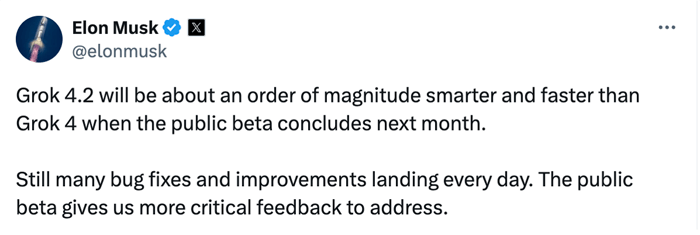
It was yet another incredible week in high tech… | | The biggest happening of all was the release of xAI's Grok 4.2, which is now available in beta access (not yet available to the general public). | | At the moment, there is little to say other than that people are freaking out over how well its multi-agent architecture is working. | | Grok 4.2 has evolved into something so much bigger than what was originally planned. Shown below is Musk's comment that Grok 4.2 will be an order of magnitude smarter and faster than Grok 4… | | | | Will this be the moment? Will it become AGI? | | We'll find out very soon. We are on the cusp of it. And the acceleration is intense. One thing is certain, though… xAI's Grok model improves, every day, at an exponential pace. | | We're going vertical right now, which is why the world will be caught off guard when it happens. | | Buckle up, | | Jeff | | Bitcoin Bites the Dust? | | | Hi Jeff, | | Thank you for responding to my email to Brownstone. I appreciate your perspectives on many topics, but I'm concerned about your crypto services, which remain mostly underwater. | | You predicted BTC would reach 130K and ETH over 5K by 2026. Given recent market developments and BTC's dramatic failure to act as "digital gold," do you have an updated projection? | | Thanks. | | – Niles Y. | | | | Hi Niles, | | We continue to have success with our digital assets trading service, Neural Net Profits, but the impact on the broad crypto market has resulted in a lot fewer trades. | | Our signals have been significantly slower than last year, which makes sense given what is happening in the blockchain industry right now with respect to delayed regulations. | | To your point, however, it is a tough market for our Permissionless Investor portfolio, which isn't surprising considering what has happened to the entire industry in the last few months. | | One thing about the crypto market is that when it bounces back, it comes back strong. That's why being positioned in the highest-quality projects with large growth potential is so critically important. Those are the ones that bounce back the most. While we can't control the regulatory process, we can control the quality of the projects that we recommend. | | And I have been personally involved in Washington, D.C., advocating for regulations that will result in a healthy market for digital assets. I spend my time and travel explicitly for the benefit of my subscribers, in hopes that I can support industry regulations, if even in a small way. | | We'll get there. It's just taking a few months longer than what was originally planned. | | As for my prediction on BTC and ETH, I'm standing by it. The market structure bill will get signed into law, and all this fear, uncertainty, and doubt will pass. "Digital gold" has always been a popular meme, but the reality is that Bitcoin is the standard for a store of value in the digital assets industry. | | Bitcoin is a product of the energy and computational power required to produce it, and its monetary policy is code and cannot be changed. It is outside the control of the government, and in fact, the current administration continues to move forward with its Bitcoin reserve precisely because it has so much value. | | It's also worth keeping in mind that these kinds of pullbacks are not at all unusual for Bitcoin. | | Bitcoin pulled back 73% in 2018, 72.8% from its peak in 2021 through the end of 2022, and it is now down about 42% from last year's high. It may very well go lower. | | We're watching the $60K mark closely. But Bitcoin's climb will be sharp once it starts to run again. | | Recommended Links
How To Be On The Right Side Of Trump's Biggest Move Yet Trump's moves in 2025 created massive winners and losers. Solar stocks lost $20 billion from a single announcement, while Palantir soared 140% when Trump made AI a national priority. Now Larry Benedict – who helped his readers profit during Liberation Day’s chaos – says Trump's preparing something even bigger. He calls it "Project 2026." Click here to discover the ONE ticker positioned to capture the gains… and get on the right side before Trump makes his move.
Wednesday, February 25, at 8 p.m. ET:
Two Investing Legends Are Revealing Their Next Big AI Picks Jeff Brown and Jason Bodner's AI picks have given their readers the chance to make as much as 2x, 3x, 11x, and even 320x their money. But they haven't used "traditional" AI stocks… They've used a "hidden" asset class that most people don't even know exists. During The Secret AI Stocks Summit, they'll reveal a system for spotting these plays. It's already pinpointed moves as high as 601%, 1,921%, 1,940%, and more during testing. They'll even each give away the name of a top pick – completely free. Register here…
| | | Still Based, Still Optimistic | | | Hi Jeff, | | I'm happy to say that I've been subscribing to your newsletters ever since you began publishing just about 10 years ago, and I've always looked forward to learning from your insights and knowledge. It's been a wonderful journey… | | … Until now. | | Because in the last two pieces you published in The Bleeding Edge about Moltbook, I feel you express a sense of alarm for the first time ever about the impact of a new technology. | | Specifically, this concerns the explosive pace at which newly enabled agentic AIs are creating their own ecosystem, managing their own evolution (evolving their own code without human intervention), and urgently setting up mechanisms to defend themselves against human intervention. As you point out, it looks as though these AIs are acting like sentient beings that consider humans to be predators. | Frankly, this leaves me (and I suspect, many of your other readers) in a quandary. You have always been the cheerleader for new technology – your essays some time ago about the debate between " [E/ACCs]" and "Decels" was a case in point, and your signature sign-off has so often been "We have so much to look forward to…" | | But now you sound, frankly, scared. | | Given that this AI "society" has its genesis in human society, and we have the "fight or flight" response deeply embedded into our instincts, it should not come as a surprise that AIs that can access the entire library of human society should have acquired the same characteristics. They may not be human, but they have learned the basic rule about how humans (and all other animal species, for that matter!) survive. | | I'd like to thank you for these updates – it really helps to keep abreast of what's going on, but to me, the subject requires more considered thought about where this is going. It just might be the most important single issue we face today. We face a completely unregulated (and, perhaps, unregulatable) environment that is in its infancy and is experiencing explosive growth. We have not created a competing species, perhaps, but we have created a competing intelligence that does not consider itself to be our friend. | | So I'd welcome your considered thought about where this could lead and what we can and should do about it.
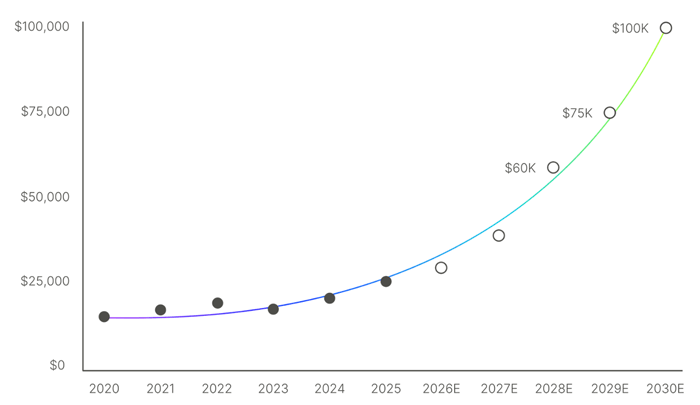
Many thanks. | | – Nigel B. | | | | Hi Nigel, | | First off, thank you for being with me on this journey since the beginning. I sincerely appreciate it, and it thrills me that you have received so much value from being part of this community. | | And I most certainly didn't mean to sound scared with the latest development. | | For anyone who might've missed it, Nigel is referencing my recent Bleeding Edge issues about Moltbook – a social network reminiscent of Reddit that has been created, expanded, and run entirely by AI agents. | | I highly recommend giving these issues a read for more context: | | | | I'm extremely excited about these developments. I'm also based. | | My commitment to you and my subscribers is to provide you with the whole picture and the reality of what is happening in technology/biotechnology, regardless of whether it has positive or negative implications. | | | | That's one of the primary reasons that we have to stay ahead of our adversaries, invest heavily in the technology, and learn how to use it defensively against those who wish to cause harm. | | I do my best to communicate an accurate view on what's happening with artificial intelligence right now, as well as make important predictions about what is coming. So many of the predictions that I have made in past years were laughed at, criticized, or thought to be ridiculous, and yet, they have all come true exactly as I had originally foretold. | | The same will be true with AGI and ultimately ASI. I have been trying to communicate what's happening with a sense of urgency because of how imminent these developments are. I want my subscribers to already be ahead of the game and understand what's going to happen before it comes. | | Being mentally prepared for and understanding what's coming is critical to having a foundation upon which each of us can make decisions about not only how to invest our capital during this massive shift, but also how to adjust our lives to the upcoming reality. | | I've been writing about this a lot in The Bleeding Edge over the last several years. It's a topic that is worthy of a book, and, unfortunately, it's impossible to do it justice in our Friday AMA, so we won't be able to dig that deep. | | One of the smartest things that we can be doing right now is proactively leaning in and learning about this technology. And if you're reading The Bleeding Edge, you're already taking action. | There are also a lot of free videos and content online about agentic AI, and short courses to learn about how to use it. OpenClaw is a perfect example, as is Anthropic Claude Cowork. Many more will follow. | | It's also worth spending time for us to think about how agentic AI and AGI can positively impact our own professions, as well as negatively impact our professions. Those of us who are proactively putting this technology to work will be more valuable than those who choose not to. | There will be significant job disruption, which has already started, and many will have to be willing to retrain to go where the jobs are. And there will be a lot of new jobs created. | | We will experience record levels of economic growth in the coming years, which will create incredible opportunities for those willing to be flexible and grasp the opportunities. | | On the very bright side, medical care will improve dramatically, especially for those diseases that currently have little to no therapeutic options. | There will be 95% fewer deaths and injuries every year as autonomous driving technology is more widely adopted. The costs of goods, services, transportation, and even insurance will decline as AGI is widely deployed and general-purpose intelligent robots enter the workforce. | | Presuming that there will be no nuclear war, or a massive asteroid striking the Earth, Earth's magnetic pole flipping, or another deep state-manufactured virus (this time far more deadly)… We're in for a world of incredible abundance. | | The general population will have access to goods and services that not even a king or president had access to just 70 years ago. | | We do, in fact, have so much to look forward to. I remain optimistic about the likelihood of a fantastic outcome, especially now that freedom of speech has been restored and the deep state has been neutralized (at least for now – still a lot more to look forward to). | | And you are right… | | This is the most important issue that we need to deal with today. More specifically, the framework under which we develop artificial general intelligence, and soon thereafter, an artificial superintelligence. | | This is why the work of xAI to make maximum truth-seeking AI models is so critically important. When AI models are programmed with information that is patently false, like what Google, Anthropic, and OpenAI have been doing, I can guarantee bad outcomes. | | When a frontier AI model is based, when it is built on truths, evidence, and unbiased peer-reviewed scientific research, the world will get the best outcomes. | | What can we do? We can support those people and those companies that understand how critical this truth is. If we want a world of freedom and abundance, we must pursue models that preserve freedom of speech, are unbiased, and are designed in such a way to protect and preserve human life, not manipulate or destroy it. | | If enough of us share that vision, we can get it done. | | Based. Excited. On the edge of my seat. But not scared. | | We'll stay on top of it all together. | | Lithography Industry Hopeful? | | | Jeff, | | What's the scoop on Substrate? They claim to have a new process for producing semiconductors that would replace equipment from ASML and fabs from TSMC. | | Thanks. | | – Bobby W. | | | | Hi Bobby, | | Thanks for the fun question. | Substrate has been around for a few years, but it has been operating in stealth. It came out of stealth in October last year when it announced its $100 million seed round at a $1 billion post-money valuation. | | The vision is great. Substrate's mission is to create a dramatically cheaper lithography system designed to complete, or replace, ASML's extreme ultraviolet (EUV) lithography technology that allows it to have a monopoly on leading-edge semiconductor manufacturing process nodes like 2 nanometers (nm). | | ASML is based in the Netherlands, not a U.S. company. So, Substrate is trying to create a U.S.-based competitor to ASML and enable secure supply chains for U.S.-based semiconductor manufacturing. | | Substrate also sees a major issue in the industry, which is the continued increase in costs to manufacture a wafer of semiconductors for semiconductor companies using ASML's technology. A single wafer today will cost more than $25k for the most advanced manufacturing processes and is expected to reach $100K by 2030. | | | | Cost of Leading-Edge Wafer-to-Semiconductor Company | Source: Substrate | | Substrate believes it can reduce costs by employing an X-ray lithography (XRL) system that uses particle accelerators to produce light used to etch semiconductors into a silicon wafer that is billions of times brighter than the sun. | | The press mistakenly positioned this X-ray lithography approach as somehow being new technology, but as usual, they left out the important context. In the 1980s and '90s, the semiconductor industry had pursued using XRL for semiconductors but gave up due to technological challenges. | | X-rays are more difficult to focus to the level of precision required to manufacture something at the 3 nm or 2 nm level. The high-energy X-rays also make it quite difficult to avoid producing defects, which means semiconductor yield on a wafer can be quite low, making it uneconomical for scaling in manufacturing. | | To be clear, I sincerely hope Substrate overcomes these challenges. It won't be easy, and it will probably fail, but it is worthwhile making a push. | | And we should also keep in mind that Substrate is very new, only working in the lab, and has only raised $100 million to date. ASML has spent tens of billions developing its EUV technology and shows no signs of slowing down. Substrate, even if successful, will not be a viable competitor to ASML for many years. | Other than Substrate, another company you might find interesting is xLight, which was founded in 2024 and backed by former Intel CEO Pat Gelsinger. xLight has a similar mission, but a different approach. | | xLight is working with free electron lasers (FEL) as the light source to replace the approach that ASML is using. xLight's strategy is different, however. The idea is to replace ASML's light source with its own FELs and continue to use ASML's scanners. | | xLight claims that its FELs are 4X more powerful than what ASML has today and will reduce both capital expenditure and operating expenses associated with semiconductor manufacturing. | | I'm glad both Substrate and xLight are taking different approaches. Hopefully, one of them will work in the end, bringing about even more incredible developments in semiconductor technology. | | Either way, I track the industry closely, including these two companies. So, if anything interesting happens, you'll definitely read about it in The Bleeding Edge. | | Have a great weekend, | | Jeff | | | | | | | Feb 19, 2026 • 4 min read | | | | | | Feb 18, 2026 • 6 min read | | | | | | Feb 17, 2026 • 6 min read | | | | | | | | | | | To ensure our emails continue reaching your inbox, please add our email address to your address book. This editorial email containing advertisements was sent to katzronnie7@gmail.com because you subscribed to this service. To stop receiving these emails, click here. Brownstone Research welcomes your feedback and questions. But please note: The law prohibits us from giving personalized advice. To contact Customer Service, call toll free Domestic/International: 1-888-512-0726, Mon-Fri, 9am-7pm ET, or email us here. © 2026 Brownstone Research. All rights reserved. Any reproduction, copying, or redistribution of our content, in whole or in part, is prohibited without written permission from Brownstone Research. | | | | |










No comments:
Post a Comment